
In September 2027, world leaders will gather for the final SDG Summit before the Agenda 2030 deadline – an event that the 2024 Pact for the Future explicitly frames as an opportunity to “advance sustainable development by 2030 and beyond” (Action 12.b). The period leading up to the Summit is therefore pivotal for rethinking global cooperation for sustainable development, and for advancing the reforms needed to equip the UN system with the vision, methods, tools and financing required to address twenty-first-century global challenges, including climate change, collective security and the impact of new technologies.
Nation states remain at the heart of the UN system. They vote at the General Assembly, ratify international treaties, participate in UN organizations and, more broadly, either uphold or depart from the principles established in the UN Charter. SDG 17 (Partnerships for the Goals) emphasizes the importance of global cooperation for achieving the SDGs. It is therefore critical to track countries’ commitment to supporting UN-based multilateralism systematically and regularly.
This chapter presents an updated and expanded version of the Index of countries’ support for UN-based multilateralism (UN-Mi), including aggregate results as well as detailed results by indicator. The Index covers all 193 UN member states. The UN-Mi has benefited from several rounds of comments collected since 2022 on pilot versions and was presented in detail in a 2024 peer-reviewed paper (Lafortune and Sachs, 2024). The Index is now used as an indicator in UNDP’s 2025 Global Knowledge Index (UNDP and MBRF, 2025).
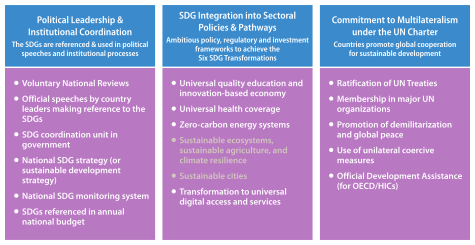
The UN-Mi draws on six indicators to gauge countries’ commitment to UN-based multilateralism (Figure 3.1). This chapter presents each indicator in detail, outlining its methodology, data sources and results. For clarity, most charts in this chapter focus on G20 and large countries, which collectively account for almost three quarters of the world’s population. We also include in each chart the global median as a measure of central tendency across the 193 UN member states, because the median is less affected by outliers than the average.
Figure 3.1 | SDSN’s Index of Countries’ Support for UN-Based Multilateralism (UN-Mi): conceptual framework
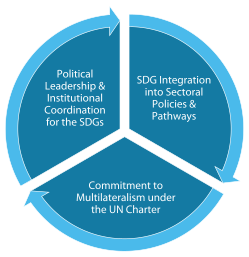
Source: Authors, based on Lafortune and Sachs, 2024
Detailed data for all countries is accessible at: https://sdgtransformationcenter.org/.
3.1. The 2026 UN-Mi: rankings and scores
Overall, as of 2026, a majority of countries continue to adhere to the basic principles established in the UN Charter. The average UN-Mi score is 65 out of 100, while the median is 66. The UN-Mi country scores and rankings are broadly robust to statistical and methodological adjustments, especially at the top and bottom of the distribution.
Using statistical methods, we group countries into the following five categories:
- Category 1 corresponds to countries that demonstrate very strong support for UN-based multilateralism, with scores above the global mean plus 0.5 standard deviation. The countries in this category tend to perform well on all six indicators of the UN-Mi. Barbados tops this year’s UN-Mi, followed by Antigua and Barbuda, then Uruguay, Trinidad and Tobago, the Maldives, Jamaica, Mauritius, Chile, the Philippines, and Malaysia. Among the G20 and large countries, Brazil, Mexico, the Philippines and South Africa fall in this category.
- Category 2 corresponds to countries that demonstrate strong support for UN-based multilateralism and perform above the global average, with scores within 0.5 standard deviations above the mean. These countries typically score well on most indicators, although their performance may be weaker on one of the six. Countries such as Argentina, Bangladesh, Germany, Indonesia, Japan and Nigeria fall in this category.
- Category 3 corresponds to countries that demonstrate moderate support for UN-based multilateralism, performing only slightly below the global average, with scores within 0.5 standard deviations below the mean. Australia, Canada, the Arab Republic of Egypt, Ethiopia, India, Italy and the Republic of Korea fall in this category.
- Category 4 corresponds to countries that demonstrate inconsistent support for UN-based multilateralism, with scores below the mean minus 0.5 standard deviations. Some countries in this category tend to perform poorly on the indicator related to participation in conflicts and militarization. China, France, Pakistan, the Russian Federation, Saudi Arabia, Türkiye and the United Kingdom fall into this category.
- Finally, category 5 corresponds to countries that exhibit weak support for UN-based multilateralism or to statistical outliers (countries that perform below the lower-fence threshold, defined using Tukey’s fence1 as a reference point). There are only four countries in this category: the Democratic People’s Republic of Korea, Israel, South Sudan and the United States. The United States ranks last among the 193 UN member states, with very low performance across all six headline indicators.
The 2026 UN-Mi rankings and scores are presented in Figure 3.2. Arrows indicate whether each country’s support for UN-based multilateralism has improved substantially or moderately, declined, or remained broadly stable over the period 2015–2025. These trends are measured using the same indicator set as the UN-MI scores, apart from the ratification of UN treaties and membership in UN organizations, both of which are currently more difficult to track systematically for all countries over time. Overall, support for UN-based multilateralism has declined in many countries, driven mostly by increased military expenditure and participation in conflicts. For European countries, this decline has also been driven by an increase in the use of Unilateral Coercive Measures (UCMs) compared with the baseline.
Figure 3.2.a | 2026 UN-Mi Rankings and Scores
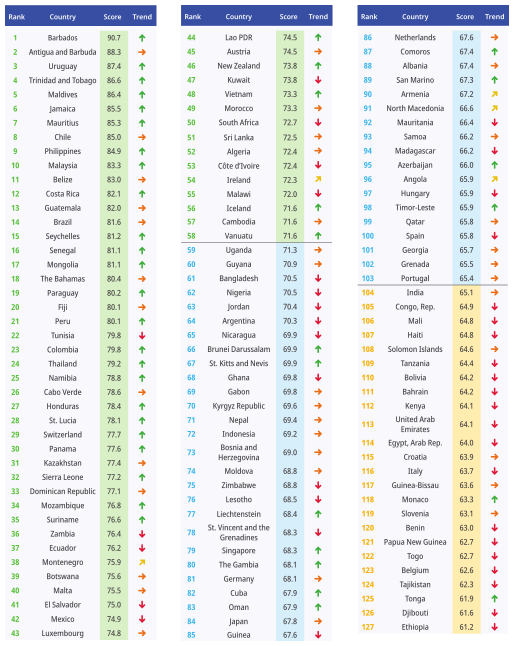
Note: See statistical annex for details on clustering.
Source: Authors
Figure 3.2.b | 2026 UN-Mi Rankings and Scores (continued)
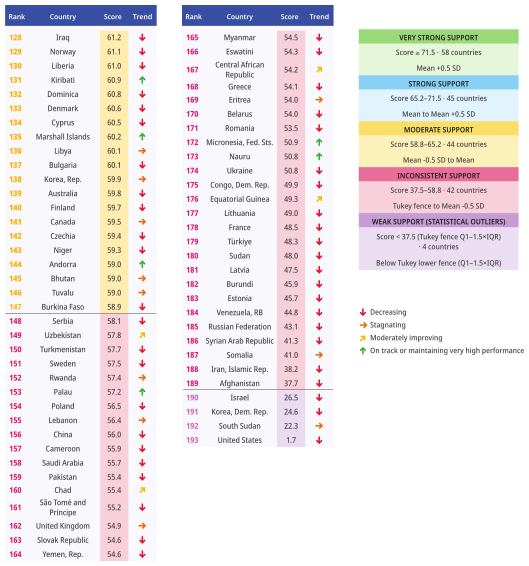
Note: See statistical annex for details on clustering.
Source: Authors
3.2. Detailed UN-Mi results by indicator
3.2.1. UN-Mi Indicator 1: Ratification of major UN treaties
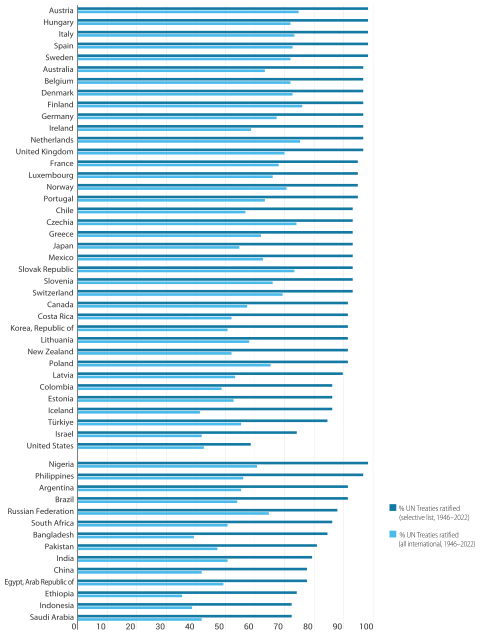
The first indicator measures the percentage of major UN treaties that each country has ratified. It covers 60 international conventions and agreements adopted by the United Nations between 1946 and 2025, as well as instruments adopted before 1946 and later incorporated into the UN treaty system. The indicator includes UN instruments ratified by more than 50 percent of the international community, while excluding protocols, optional protocols, amendments, and conventions that were later terminated or applied only to a small number of countries. Treaties adopted outside the United Nations system or deposited by parties other than the UN Secretary General, such as the Geneva Conventions, adopted under the auspices of the International Committee of the Red Cross (ICRC), were also excluded. For each treaty, we recorded in our database (accessible online) whether each member state had signed or ratified it. Signature of a treaty is not legally binding, however ratification (or acceptance, accession, definitive signature or succession) is. The data were extracted from the UN treaty collection on 29 January 2026.
The global median is 85 percent (Figure 3.3), suggesting that an overwhelming majority of countries generally ratify important UN treaties. Among G20 and large countries, Italy, Nigeria, Australia, Germany, the Philippines, the United Kingdom and France have ratified more than 95 percent of major UN treaties. By contrast, the United States is one of the ten countries in the world that have ratified fewer than 60 percent of major UN treaties. In early 2026, the US withdrew from the Paris Climate Agreement.
Figure 3.3 | Ratification of major UN treaties by G20 and large countries, 1945–2025 (%)
Note: Using a basket of treaties ratified by more than 50 percent of UN member states (N=60) as of 2024. Global median (85 percent) corresponds to the median percentage of major UN treaties ratified across all 193 UN member states. African Union (AU) and European Union (EU) not included – only G20 countries.
Source: Authors’ calculations based on UN treaty database.
3.2.2. UN-Mi Indicator 2: Percentage of votes aligned with the international majority at the UN General Assembly
The second indicator concerns the percentage of a country’s votes at the UN General Assembly (UNGA) that align with the international majority. Chapter IV of the UN Charter describes the role and functions of the General Assembly, the main decision-making body of the United Nations. This indicator measures the percentage of times that each member state has voted with the simple international majority (not weighted by population), out of 550 recorded votes over the period 2021–2025. Overall, since 1945, votes on more than 5,000 UNGA resolutions have been reported in the UN digital library (data were obtained via a Python web scraping pipeline). For each resolution, UN member states can vote yes or no, abstain, or be absent. In the vast majority of cases, 98 percent of the time, the majority vote is “Yes”.
The global median for alignment with the majority vote is 76 percent. Bangladesh, Brazil, the Arab Republic of Egypt, Ethiopia, Indonesia, Mexico, the Philippines and Saudi Arabia aligned with the majority vote at least 80 percent of the time (Figure 3.4), whereas Argentina, Australia, Canada, France, Germany, Italy, the Republic of Korea, the Russian Federation and the United Kingdom aligned with the majority around two thirds of the time. The United States, however, aligned with the international majority vote only 23 percent of the time on average from 2021 to 2025. Focusing only on 2025, the US vote aligned with the international majority in only around 5 percent of recorded UNGA votes, across 192 resolutions, and notably opposed important resolutions related to sustainable development and climate action.
Figure 3.4 | Percentage of votes aligned with the majority at the UN General Assembly, G20 and large countries, 2021–2025
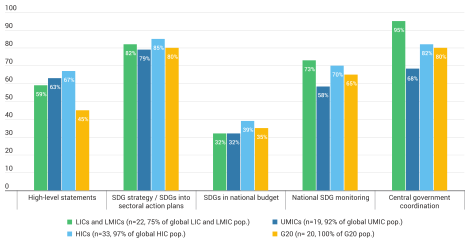
Note: Simple majority (not population weighted). Votes recorded between 2021 and 2025 (N=550). Global median (76%).
Source: Authors’ calculations, based on UN Digital Library voting data.
Yet support for sustainable development remained strong at the UNGA in 2025, with related resolutions receiving sizeable majority votes. Table 3.1 presents detailed 2025 voting results for all UNGA resolutions that included the term “sustainable” or “2030 Agenda” – including resolutions on financing, energy connectivity, education, biodiversity preservation, consumption and production, and digital technologies for sustainable development. Most were adopted with a very large majority, often exceeding 170 countries, with only a very small minority voting against them – often only two or three countries – while several abstained or were absent. The two countries that opposed these resolutions almost systematically were Argentina and the United States.
Table 3.1.a | Results of 2025 UNGA votes on resolutions containing “sustainable” or “2030 Agenda”
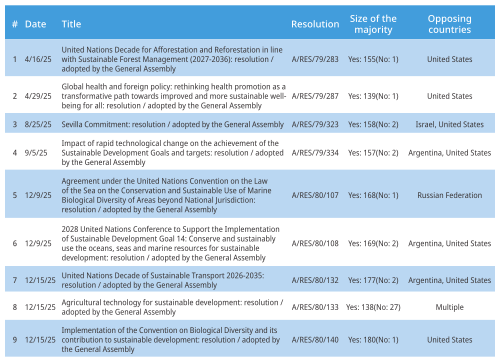
Note: The Sevilla Commitment – resolution A/RES/79/323, adopted by the General Assembly – was retained because it is strongly related to financing sustainable development.
Source: Authors, based on UN voting database
Table 3.1.b | Results of 2025 UNGA votes on resolutions containing “sustainable” or “2030 Agenda” (continued)
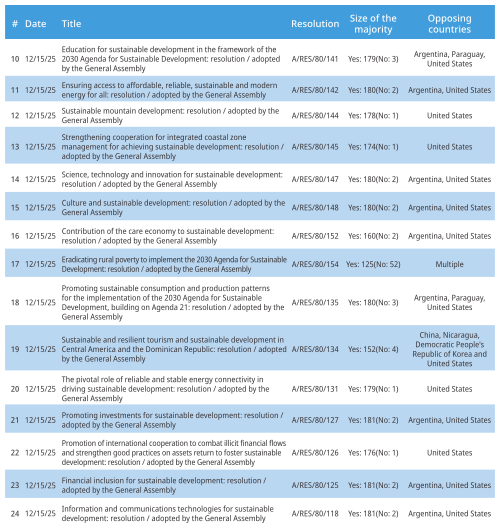
Note: The Sevilla Commitment – resolution A/RES/79/323, adopted by the General Assembly – was retained because it is strongly related to financing sustainable development.
Source: Authors, based on UN voting database
Compared with the early years of the United Nations, the share of countries’ votes at UNGA that align with the United States has declined notably in all regions, a trend that accelerated in several regions during the 1980s. In 2025, this decline reached a turning point: voting alignment with the United States fell to 20 percent or less across all world regions (Figure 3.5). Despite this broad pattern, there remains significant variation in UNGA voting patterns within regions, with Israel being by far the country voting most often in alignment with the United States over the past five years.
Figure 3.5 | Share of UNGA votes aligned with the United States over time: decadal averages and 2025 standalone value
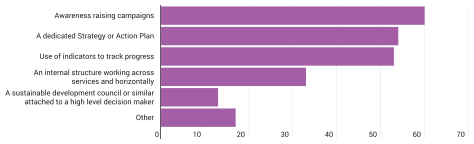
Note: Afghanistan and Pakistan were included in the South Asia grouping.
Source: Authors, based on UN voting database
3.2.3. UN-Mi Indicator 3: Participation in selected UN organizations and agencies
The third indicator measures membership and participation in a select group of UN organizations. Chapter IX of the UN Charter describes the role of the specialized agencies2 in fostering international economic and social cooperation. The indicator captures membership in 24 organizations as of March 2025: all 15 specialized agencies, the 6 funds and programmes (UNDP, UNEP, UNFPA, UN-HABITAT, UNICEF and WFP), the Conference on Trade and Development (UNCTAD), the Framework Convention on Climate Change (UNFCCC) and the World Trade Organization (WTO). These were selected to include all the specialized agencies and to represent a broad range of sustainable development issues, including education, health, finance, trade, telecommunication and industrial policy.
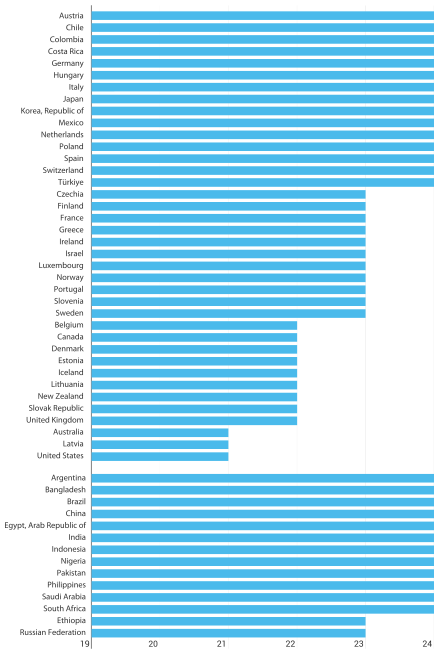
Most of the 193 UN member states participate in all 24 selected organizations: the global median is 24, the maximum is 24, and the minimum is 12. Most G20 and large countries are members of all 24 organizations (Figure 3.6) – however Argentina announced in February 2025 that it would leave the WHO; Australia is not a member of UNIDO, UNWTO or IFAD; Canada and the United Kingdom are not members of UNIDO or UNWTO; France left UNIDO in 2014; Ethiopia is not a member of the WTO; and the Russian Federation is not a member of UNWTO.
Figure 3.6 | Membership in selected group of 24 UN organizations, G20 and large countries, 2026
Note: Global median and maximum = 24.
Source: Authors, data compiled via desk research on individual organizations and agencies’ web portals.
The United States is both an outlier among G20 and large countries and a global outlier in terms of participation in UN organizations. In January 2025, the US federal administration withdrew from 66 UN organizations.
3.2.4. UN-Mi Indicator 4: Participation in conflicts and militarization
The fourth indicator concerns countries’ participation in conflicts and their degree of militarization. The Preamble to the 1945 UN Charter states that all UN member states must “practice tolerance and live together in peace with one another as good neighbors, and “unite our strength to maintain international peace and security” (United Nations, 2025). Several UN resolutions and reports highlight the link between disarmament and development.
In 2025, the UN Secretary General published a report titled The Security We Need: Rebalancing Military Spending for a Sustainable and Peaceful Future” (United Nations, 2025), which argues that: “Growing military expenditure today is crowding out resources essential for social investment, poverty reduction, education, health, environmental protection and infrastructure – undermining progress on nearly all the Sustainable Development Goals” (p. 6).
The report later warns that: “Based on possible projected scenarios of military spending levels, by 2030, the world could allocate between $840 billion and $2.5 trillion more to military spending than what was spent in 2024. This represents an enormous amount of financial resources that, if invested in sustainable development, would contribute significantly to achieving the 2030 Agenda.” (p. 32)
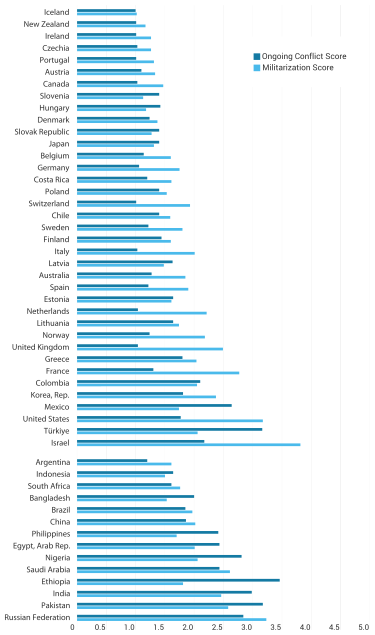
Our “Participation in conflicts and militarization” indicator relies on data from the 2025 Global Peace Index (GPI), compiled by the Institute for Economics and Peace (IEP 2025). It is calculated as the average of a country’s score on the GPI’s “Militarisation” domain and on the two external dimensions of the “Ongoing Conflict” domain: “relations with neighboring countries” and external conflicts (number and resulting mortality). The Militarization pillar includes comparable data on military expenditure as a percentage of GDP, the number of armed service personnel per capita, and financial contributions to United Nations peacekeeping missions. Among G20 and large countries, Argentina, Australia, Brazil, Canada, Germany, Indonesia, Italy, and the Philippines perform best on this indicator, with scores below the global median (Figure 3.7). By contrast, the Russian Federation performs the worst globally, while Türkiye and the United States also score well above the global median.
Figure 3.7 | Global Peace Index: militarization and external conflicts, G20 and large countries, 2025
Note: from 1 (best, less militarized) to (5, worst, more militarized). Global median (1.86).
Source: Authors’ calculations based on IEP, 2025.
3.2.5. UN-Mi Indicator 5: Use of unilateral coercive measures
The fifth indicator relates to the use of unilateral coercive measures (UCMs). This indicator examines the adoption by UN member states of unilateral sanctions against other countries. Several UN resolutions stress that unilateral coercive measures and practices “are contrary to international law, international humanitarian law, the UN Charter and the norms and principles governing peaceful relations among States” (OHCHR, 2023). They also underline that, in the long term, such measures may create social problems and raise humanitarian concerns in targeted states. Reflecting these concerns, the Human Rights Council in 2014 created the mandate of the “Special Rapporteur on the negative impact of unilateral coercive measures on the enjoyment of human rights”.
The 2030 Agenda stipulates that: “States are strongly urged to refrain from promulgating and applying any unilateral economic, financial or trade measures not in accordance with international law and the Charter of the United Nations that impede the full achievement of economic and social development, particularly in developing countries.” ((United Nations, 2015), para 30)
The data on UCMs presented in this report are sourced from the Global Sanctions Database, version 4, 2024, which provides information on sanctions imposed against countries, including data from the start and the final year of each sanction imposition (Felbermayr et al., 2020; Drexel University, HTWG Konstanz and WIFO, 2024). Here, we present sanctions adopted unilaterally between1950 and 2023 that remained in place as of 2023 or later. For our purposes, a sanction is classified as unilateral if it has not been authorized by the UN Security Council, even when imposed by multiple countries. Sanction regimes adopted unilaterally by regional organizations, such as the European Union or the League of Arab States, have been attributed to their individual member states.
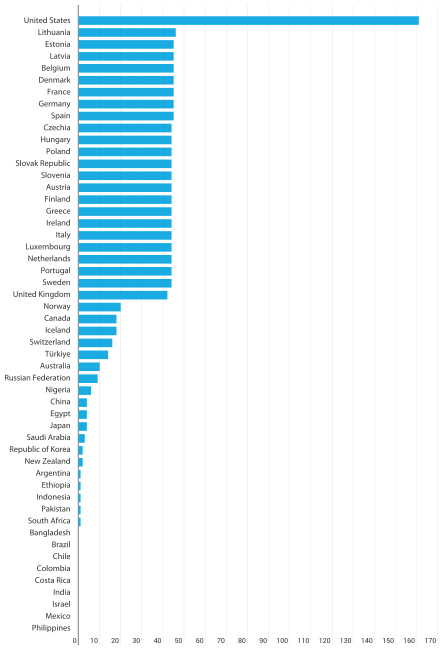
Only a small number of countries make frequent use of UCMs as a policy tool; the global median number of UCM uses over the period 1950–2023 is four. The United States is by far the most significant user of UCMs, particularly since the late 1980s and early 1990s, followed by European countries.
3.2.6. UN-Mi Indicator 6: Contribution to the UN budget and international solidarity
The sixth indicator relates to each country’s contribution to the UN budget and to international solidarity. Articles 17 and 19 of the UN Charter set out the organization’s financial and budgetary arrangements, while the UN Fifth Committee addresses administrative and budgetary matters. The capacity to pay remains the core principle for determining each member state’s contribution to the United Nations’ regular and peacekeeping budgets. On this basis, the United Nations establishes a scale of assessments to apportion expenses for its regular budget and for peacekeeping operations. The UN core budget in 2025 was equivalent to 3.7 billion USD. For the period 2025–2027, the United States and China are the largest contributors, each accounting for more than 20 percent of both the regular UN budget and peacekeeping operations.
The UN Fifth Committee keeps a record of countries that pay their dues on time, those with delayed payments, and those in extreme arrears. Countries in significant arrears are subject to the provisions of Article 19: “a Member of the United Nations which is in arrears in the payment of its financial contributions to the Organization shall have no vote in the General Assembly if the amount of its arrears equals or exceeds the amount of the contributions due from it for the preceding two full years.”
Figure 3.8 | Use of unilateral coercive measures, G20 and large countries (1950–2023)
Note: UCMs adopted between 1950 and 2023 that continued into 2023. The global median is four.
Source: Authors, based on Global Sanctions Database, V4, 2024.
Figure 3.9 | Timeliness of payment of dues to the United Nations, G20 and large countries, 2021–2025
Note: Scores range from 100 (systematically paid on time), to 66 (small delays in payment), 33 (large delays in payment), and 0 (for countries subject to Article 19 because of extreme arrears). The global median score is 66, corresponding to small delays in payment. Scores are computed as the simple average across the years 2021–2025.
Source: Authors, based on UN Committee on Contributions.
Since contributions to the UN budget are determined by the principle of capacity to pay, we do not rate countries on the total amount they pay. However, no matter the level of their contribution, every country can be expected to pay their dues on time, to ensure the effective functioning of the UN system.
This indicator focuses on delays in payment of UN dues over the period 2021–2025. A member state receives a perfect score of 100 for each year in which it appears on List I of the UNGA Committee on Contributions’ “honour roll“, indicating that it has paid its dues in full and on time ( paid on time ). Members appearing on List II, which indicates that dues have been paid, but after the 30-day due period, receive a score of 66 ( small delay in payment). Those absent from the honour roll receive a score of33 ( large delay in payment). Countries still in arrears in their financial contributions in January of the subsequent year receive a score of 0, based on the list published on the UN General Assembly’s dedicated Article 19 page ( extreme arrears in payment). Final scores correspond to each country’s average across 2021–2025.
Figure 3.10 | Official Development Assistance (ODA), as a percentage of GNI, OECD/DAC countries (aggregate), 1960–2024
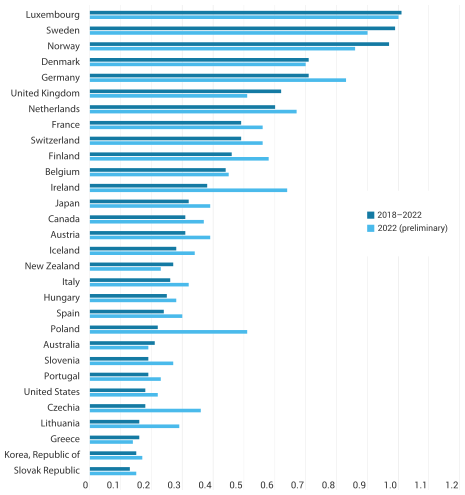
Note: ODA on flows and grant equivalent measure by DAC member countries as percent of GNI. 2020–2025 in grant equivalent.
Source: OECD 2026
From 2021 to 2025, 23 countries systematically paid their dues to the United Nations on time, within the 30-day due period. Some countries, however, such as Afghanistan, São Tomé and Principe, and the Bolivarian Republic of Venezuela, were in extreme arrears in payment in 2023, 2024 and 2025. As largely documented, delays in payment by some of the largest contributors to the regular UN regular budget and peacekeeping operations in recent years represent a significant operational challenge for the effective functioning of the UN system.
3.3. Outlook
The United Nations, founded in 1945 by just 51 member states, now faces a world of far greater complexity than its architects could have anticipated. The challenges of the 21st century – from climate change and environmental degradation to emerging security threats and rapid technological transformation – demand a multilateral system fit for purpose in a fundamentally different era.
From February to April 2026, the SDSN organized a four-part webinar series, “Global Governance for Peace and the SDGs”, designed to make sense of today’s rapidly evolving global challenges, share best practices, and identify solutions for sustainable development beyond 2030. From these global exchanges, several interconnected reforms emerged that could help revitalize UN-based multilateralism.
First, it was highlighted that regional bodies such as the European Union, the African Union, and ASEAN, as well as subnational entities including cities and municipalities, have become significant actors in global governance. The UN must find better ways to incorporate regional realities and subnational perspectives into its frameworks.
Second, the question of representation has never been more pressing. The UN has grown from 51 to 193 member states – Africa alone has gone from 4 members in 1945 to 54 in 2025 – yet its core structures still reflect a post-war balance of power that no longer exists.
Meaningful reform must ensure that this diversity of voices is genuinely heard, with some advocating for the creation of a UN Parliament to give fuller institutional expression to the principle of “We the People”.
Third, the UN must sharpen its focus on moving from aspiration to action, prioritizing the development of concrete long-term pathways to sustainable development and stronger implementation mechanisms. Fourth, and closely related: adequately financing the UN and global public goods remains a critical priority. The UN currently operates with a core annual budget roughly equivalent to 45 cents per person globally, which is highly inadequate for addressing the growing shared challenges of our time. On top of this, many countries are paying their dues late. Innovative financing mechanisms, such as levies on international shipping, aviation, financial transactions or carbon emissions, could generate the revenues needed to fund the UN and global public goods properly and to strengthen the institutions that deliver them. Addressing duplications in mandates across UN agencies is important, as emphasized in the UN80 initiative, but the UN also needs to be properly financed.
Finally, and perhaps most fundamentally, the UN’s effectiveness depends on countries’ adherence to the norms and principles they have collectively endorsed. This means embracing both collective security, in which the majority stands firmly against aggression and bullying behaviour by any state, and the principle of indivisible security, which recognizes that lasting peace and stability cannot be built on arrangements that undermine the security of others. Without this shared commitment, even the best-designed institutions will fall short. Tracking countries’ commitment to basic UN principles and norms is precisely the aim of SDSN’s annual Index of Countries’ Support for UN-Based Multilateralism (UN-Mi).
The recordings of SDSN’s four-part webinar series, “Global Governance for Peace and the SDGs” are accessible here: https://www.unsdsn.org/news/beyond–2030-governing-fora-sustainableglobal-future/
3.4. Annex: Statistical appendix: UN-Mi groupings
Score interpretation: Scores range from 0 to 100. A higher score indicates stronger commitment to UN-based multilateralism, assessed across six headline indicators: treaty ratification, UNGA voting alignment, participation in UN organizations, participation in conflict and militarization, use of unilateral coercive measures, and financial contributions to the United Nations. See the online codebook and the peer-reviewed paper by Lafortune and Sachs (2024) for details on normalization and aggregation methods.
Groups 1–4, mean ± 0.5 standard deviation: The distribution is divided into four groups using the global mean, 65.2, and the standard deviation, 12.6, as anchors. Each group spans 0.5 standard deviations above or below the mean, a standard approach for identifying meaningful performance bands in index rankings.
Group 5, Tukey lower-fence threshold: The lower-fence threshold defined by Tukey’s criterion(Q1 − 1.5 × IQR = 59 − 21.4 = 37.6) identifies extremely low outliers. The four countries below this threshold (Israel, the Democratic People’s Republic of Korea, South Sudan and the United States) have z-scores ranging from -3.1 to -5.0, confirming their extreme statistical separation from the rest of the distribution.
Figure 3.11 | UN Multilateralism Index 2026, statistical basis for five-group country classification
3.5. References
Cavalcanti, Daniella Medeiros, Lucas de Oliveira Ferreira de Sales, Andrea Ferreira da Silva, et al. 2025. Evaluating the impact of two decades of USAID interventions and projecting the effects of defunding on mortality up to 2030: a retrospective impact evaluation and forecasting analysis. The Lancet, 406 (10500): 283–94. https://doi.org/10.1016/S0140-6736(25)01186-9 .
IEP. 2025. Global Peace Index 2025: Identifying and Measuring the Factors that Drive Peace. Institute for Economics & Peace, Sydney, June 2025. Available from: http://visionofhumanity.org/resources
Lafortune, Guillaume, and Jeffrey D. Sachs. 2024. The Index of Countries’ Support for UN-Based Multilateralism: construction, verification, and correlates. Asian Economic Papers, 23 (3): 1–28. https://doi.org/10.1162/asep_a_00902.
OECD. 2026. Preliminary Official Development Assistance Levels in 2025: Detailed Summary Note. OECD Publishing. Paris, 09 April.
OHCHR. 2023. Special Rapporteur on Unilateral Coercive Measures. https://www.ohchr.org/en/specialprocedures/srunilateral-coercivemeasures
Tukey, John W .1977. Exploratory Data Analysis. Addison-Wesley. ISBN 978-0-201-07616-5. OCLC 3058187.
UNDP and MBRF. 2025. The Global Knowledge Index. United Nations Development Programme and Mohammed bin Rashid Al Maktoum Knowledge Foundation. https://www.undp.org/arab-states/publications/global-knowledge-index-2025
United Nations. 2015. Transforming Our World: The 2030 Agenda for Sustainable Development. Resolution adopted by the General Assembly on 25 September 2015, A/RES/70/1. United Nations. https://docs.un.org/en/A/RES/70/1.
United Nations. 2025. The Security We Need: Rebalancing Military Spending for a Sustainable and Peaceful Future. Report of the Secretary General. https://globalcompact.at/wp-content/uploads/2025/09/SG_Report_TheSecurityWeNeed.pdf
The Sustainable Development Report (formerly the SDG Index & Dashboards) is a global assessment of countries' progress towards achieving the Sustainable Development Goals. It is a complement to the official SDG indicators and the voluntary national reviews.
All data presented on this website are based on the publication Sachs, J.D., Lafortune, G., Fuller, G., Iablonovski, G. (2026). Implementing Sustainable Development: 2030 and Beyond. Sustainable Development Report 2026. Paris: SDSN, Dublin: Dublin University Press. DOI: 10.82163/225
Feedback? Questions? Contact us at info@sdgindex.org