
The SDGs represent a very complex challenge for governments. Their implementation requires long-term policy and investment frameworks as well as new approaches that cut across traditional government silos. In 2019, the SDSN introduced the six “SDG Transformations”, which provide a more operational framework for addressing the systemic and integrated nature of the SDGs (Sachs et al.). That same year, the SDSN worked with the OECD on a flagship study, released at the HighLevel Political Forum, that examined long-term pathways and the governance implications of the SDGs (SDSN and OECD 2019). Over the years, the SDSN has worked bilaterally with multiple national and regional governments to strengthen governance systems for the SDGs. The SDSN also regularly collects data from its global network of academics and researchers, to track the evolution of the SDG policy landscape worldwide.
This chapter evaluates SDG commitments and implementation efforts primarily at the national level. It focuses on three main information sources. First, it reviews the participation in the Voluntary National Review (VNR) process. Secondly, it presents updated results from the “2026 SDSN Expert Survey on Government Efforts for the SDGs”, covering 64 countries and one entity, the European Union. The data, collected by the SDSN secretariat in cooperation with local chairs and managers across SDSN’s networks, provide information on speeches, strategies, monitoring frameworks, budgets, audits and coordination mechanisms introduced by governments to support SDG implementation. Third, it introduces new results from the “2026 SDSN Survey on SDG Challenges and Means for Implementation”, based on responses from more than 1,000 global respondents involved in SDG implementation at the country level.
Figure 4.1 | Participation in the Voluntary National Review (VNR) process, number of countries, 2016–2026
Note: Includes the 36 countries expected to present a new VNR in 2026.
Source: Authors’ elaboration based on https://hlpf.un.org/vnrs
4.1. Voluntary National Reviews
In 2015, all 193 UN member states adopted the 2030 Agenda, committing to a “systematic followup and review of implementation of this Agenda over the next fifteen years” through voluntary, country-led reviews (United Nations 2015). These Voluntary National Reviews (VNRs) presented at the HighLevel Political Forum (HLPF), constitute an important pillar of the global accountability architecture for SDG implementation, alongside the official SDG indicator framework and reporting processes and the United Nation’s Global Sustainable Development Report (GSDR) process.
Since 2016, 190 countries have participated in the Voluntary National Review (VNR) process. In 2026, 36 countries are scheduled to present updated reviews of their SDG action plans and implementation efforts, with no first time presenters. Togo and Uruguay are scheduled to present their fifth VNRs in July 2026, making them the two countries that have prepared the highest number of VNRs globally. Haiti, Myanmar and the United States have not engaged in the VNR process, neither by submitting a full VNR report or key messages, nor by appearing on the United Nations Economic and Social Council (ECOSOC) annual list of forthcoming presenters. The Islamic Republic of Iran submitted key VNR messages in 2017 and was also formally listed as a forthcoming VNR presenter in 2024 (Impact Iran, 2017).
Increasingly, cities and regions also prepare and present their action plans for sustainable development. The UN Department of Economic and Social Affairs (DESA) reports on its website that subnational authorities in 48 countries presented 386 Voluntary Local Reviews (VLRs) over the period 2016–2026. Four countries – Brazil (72), Malaysia (44), Mexico (35) and Argentina (34) – represent almost half (48 percent) of the total number of VLRs listed by DESA. There are no signs of declining momentum in cities and regions – the number of VLRs presented annually has increased sharply since 2016, and especially over the past year – the number of listed VLRs went from 62 in 2024 to 105 in 2025 (+69 percent).
Figure 4.2 | Number of VNRs presented by G20 and large countries, 2016–2026
Note: Includes the 36 countries expected to present a new VNR in 2026.
Source: Authors’ elaboration based on https://hlpf.un.org/vnrs
Figure 4.3 | Number of Voluntary Local Reviews (VLRs) prepared by regional and/or local authorities, all countries, total (2016–2026)
Note: As of April 22, 2026.
Source: Authors’ elaboration based on UN Department of Economic and Social Affairs (DESA). https://sdgs.un.org/topics/voluntary-local-reviews
Figure 4.4 | Number of new Voluntary Local Reviews (VLRs), submissions per year, 2015–2025
Note: As of April 22, 2026. Two VLRs reported by UN DESA in 2026.
Source: Authors’ elaboration based on UN Department of Economic and Social Affairs (DESA). https://sdgs.un.org/topics/voluntary-local-reviews
4.2. SDSN Expert Survey on Government Efforts for the SDGs
The “2026 SDSN Expert Survey on Government Efforts for the SDGs” mobilizes SDSN’s local chairs and managers in universities and research centers to assess the discursive effect of the SDGs and their integration into public management practices and procedures. Box 4.1 provides details on the survey design and data-collection processes. This year’s survey builds on previous ones conducted by SDSN since 2018. A total of 65 responses were collected this year, covering 64 countries and one entity, the European Union. The results presented here are partial, and the sample may be expanded in the coming months.
Box 4.1. SDSN Expert Survey: Data collection process
The SDSN expert survey on government efforts for the SDGs collects information on the national policy landscape for sustainable development. This year’s survey builds on previous rounds of data collection conducted annually by the SDSN from 2018 to 2023. The primary respondents are SDSN national focal points – network chairs and managers – with input and verification provided by the SDSN Secretariat, through its three offices in Asia, Europe and North America, and by countries’ missions to the United Nations.
This year’s survey included 10 questions focusing on speeches, strategies, budgets, audits, national indicator frameworks and cross governmental coordination units for the SDGs. The survey also collected expert views on priorities for the post-2030 agenda. In total, 65 responses were received – covering 64 countries and one entity (the European Union). Data was collected online using Google Forms.
Several steps were introduced before (ex-ante) and after (ex post) data collection, to ensure data quality:
Survey design and testing (ex-ante, August to October 2025)
- A core team was established within the SDSN Secretariat to coordinate the survey design and data-cleaning process, under the leadership of Dr. Guillaume Lafortune.
- Drawing on previous editions, the 2026 survey instrument was piloted with three SDSN networks from different regions: SDSN Andes and SDSN Northern Europe. Feedback was collected, and adjustments were made accordingly.
- The opening sections of the survey provide a clear scope and definitions of key terms.
- For each positive response, the survey requests a link to official documentation.
Data collection and cleaning (November 2025 to April 2026)
- A team of data reviewers was established within the SDSN Secretariat to verify initial responses provided by SDSN local networks and to harmonize responses, primarily through desk research, including the use of large language models and other tools.
- A data-cleaning guide was produced to provide clear guidance and ensure a consistent cleaning process.
- Two focus groups were organized with data reviewers to address queries.
- Continuous exchanges between data reviewers and respondents took place throughout the process to clarify responses.
- Draft survey responses were shared with all UN missions in April 2026, for verification and comments.
- The core team reviewed the draft responses and made final adjustments, particularly to ensure harmonized treatment across responses.
The list of experts consulted is presented in Annex.
Source: Authors
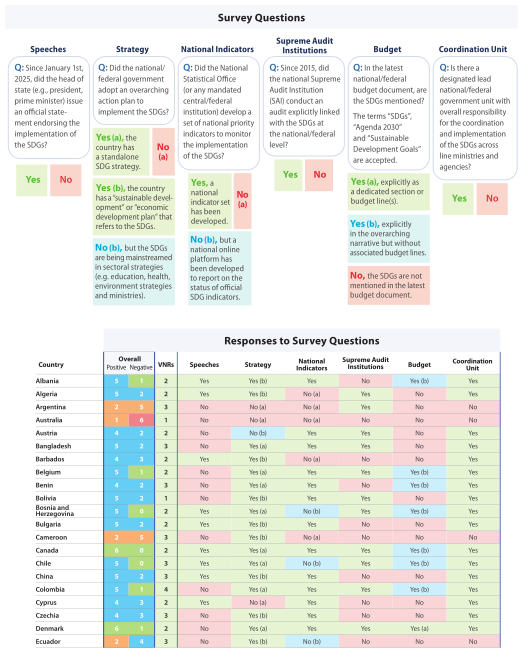
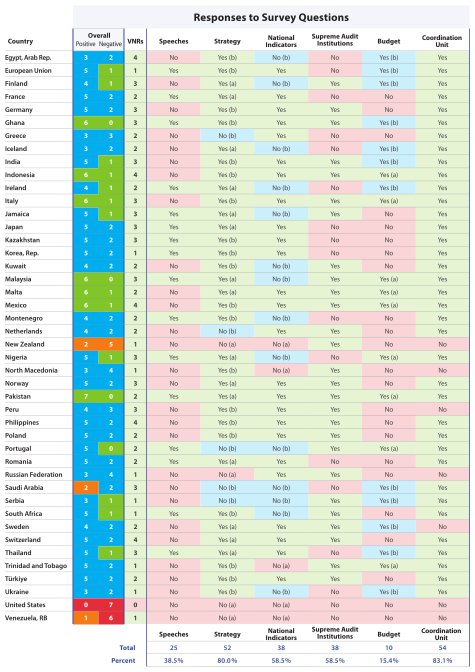
Overall, among our sample, Canada, Denmark, Ghana, Indonesia, Italy, Malaysia, Malta, Mexico and Pakistan stand out as countries that have taken major steps to incorporate the SDG framework into national government practices and procedures. By contrast, Australia, the United States and Venezuela stand out as countries that do not use the SDGs as a leading framework in public practices and procedures.
High-level speeches and discursive effects. Compared with previous editions of the survey, this year’s results show fewer references to the SDGs in speeches by heads of states, suggesting a declining discursive effect of the Goals at the highest level of government. In only about a third of countries covered in this year’s survey (38.5 percent) do we find that the head of state referred to the SDGs in an official speech in 2025, against almost two thirds (64 percent) in 2023. This may reflect shifting priorities, the deteriorating international context, and perhaps also a gradual dilution of the SDG framework in public speeches ten years after its adoption.
Strategies: Countries use different approaches to integrate the SDGs into national strategic orientations. Some have adopted standalone SDG strategies (35 percent), while others have adopted “sustainable development” or “economic development” plans that refer to the SDGs (45 percent). In other cases, the SDGs are mainstreamed in sectoral strategies and action plans for education, health, climate action and other-sectorial priorities (9 percent). In a small set of countries surveyed (11 percent), we find no significant evidence that the SDGs are being explicitly referenced in national action plans and strategies. Only a third of respondents (33 percent) consider that the main strategy adopted to advance sustainable development plays a central role in public policymaking.
Coordination units: Implementing the SDGs requires approaches that cut across traditional government silos. In 2025, a large majority of countries surveyed (83 percent) still had an SDG unit in place responsible for coordinating SDG implementation across ministries and departments. These units are typically located either within a central coordinating ministry (such as a ministry of finance, economic development, planning, environment, public service or administration, or similar) or at the center of government (president’s or prime minister’s office, cabinet office, privy council or equivalent). Assessing the effectiveness and real influence these coordination units have on government practices and operations is beyond the scope of the survey.
National monitoring frameworks: More than half of the countries surveyed (58.5 percent) have taken steps to develop national priority indicators for the SDGs. There are sizeable differences across countries in the number of national SDG indicators considered. Some have not defined national priority indicators, but report on the status of official SDG indicators (26 percent)in dedicated online portals or reports. There is also evidence that some countries discuss the results of international SDG assessments in government meetings and parliamentary sessions or set official KPIs that draw on SDG monitoring instruments (UZ Daily, 2025; Van Nguyen, 2026).
Audits: Supreme Audit Institutions (SAIs) can play an important role in evaluating government support and actions for sustainable development (UNDESA 2025). The International Organization of Supreme Audit Institutions (INTOSAI) has emphasized the importance of SAIs in strengthening national accountability frameworks for the SDGs and keeps track of SDG-related audits on its website. Drawing and expanding on this database, we find that, since 2015, a majority of countries(58.5 percent) have mobilized their SAIs for SDG-related audits. These include, for example, SAI reports on their national government’s “preparedness to implement the SDGs”, and related issues. As discussed in the 2018 edition of SDSN’s SDG Index and Dashboards Report, Canada’s Office of the Auditor general was among the first SAIs to present a report on Canada’s preparedness to implement the SDGs in 2018 (Sachs et al., 2018, p. 6).
Budgeting process: Less than half (45 percent) of the countries surveyed refer to the SDGs in their national budget, and only a small minority (15 percent) include associated budget lines. Yet 90 countries globally have taken part in the Integrated National Financing Framework (INFF) process spearheaded by UNDP, and some have also adopted sovereign financing instruments structured around the SDGs. Strengthening the integration of sustainable development into long-term financing and investment frameworks remains an important priority to bridge the gap between rhetoric and action.
Priorities for the next global agenda for sustainable development post-2030: Finally, experts were also asked to share their views on the main priorities for the post-2030 sustainable development framework. Overall, at least three-quarters of respondents consider the following six issues to be important priorities: strengthening the means for implementation (governance, data, science and other areas); developing international guidelines on SDG synergies and trade-offs; better reflecting and incorporating international spillovers; incorporating artificial intelligence (AI) into the future framework; reforming the global financial architecture; and ensuring some degree of stability in the framework, with the goals and targets remaining fairly similar (Figure 4.5).
Figure 4.5 | Priorities for post-2030 Agenda (expert opinions)
Source: SDSN Expert Survey on Government Efforts for the SDGs
Figure 4.6.a | Dashboard: Government efforts for the SDGs
Source: SDSN Expert Survey on Government Efforts for the SDGs
Figure 4.6.b | Dashboard: Government efforts for the SDGs (continued)
Source: SDSN Expert Survey on Government Efforts for the SDGs
Figure 4.7 | The role of SDG strategy in national policymaking
Note: Excludes the 13 countries without strategies or those that have adopted a sectoral mainstreaming approach (n=52).
Source: SDSN Expert Survey on Government Efforts for the SDGs
The qualitative analysis of responses to the final open-ended question reveals several thematic and geographic patterns in SDG implementation and future priorities (Figure 4.8). Most respondents highlighted the complexity of SDG implementation and the challenges their governments still face in effectively coordinating it effectively. “Long-term planning”, “data and monitoring frameworks” and “institutional coordination” emerged as recurring themes, alongside multi-level governance challenges and stakeholder engagement opportunities. SDG financing and budgeting also featured prominently. Respondents raised concerns around political will and the shifting geopolitical landscape, while also identifying priorities for the post-2030 agenda. In general, respondents from Asia-Pacific shared more positive views on SDG integration and future prospects, whereas responses from North and South America tended to focus on US disengagement and increased fragmentation as significant obstacles to SDG implementation and engagement.
Figure 4.8 | Most-cited terms in expert feedback from the SDSN Survey on Government Efforts for the SDGs
Note: Word size reflects frequency of mention with most cited terms at centre. Expert responses to Q.10. The analysis was performed using ClaudeAI (Anthropic).
Source: Authors, using ClaudeAI (Anthropic)
4.3. SDSN Large-Scale Survey on SDG Challenges and Means for Implementation
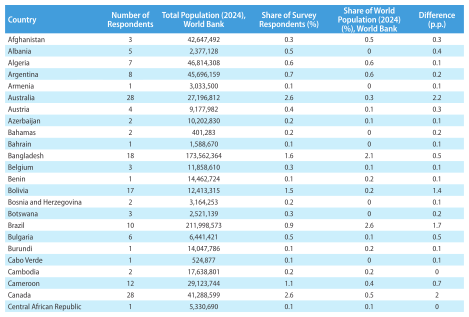
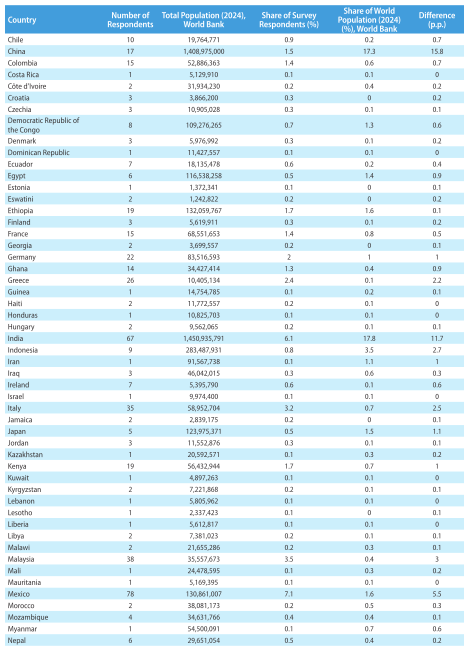
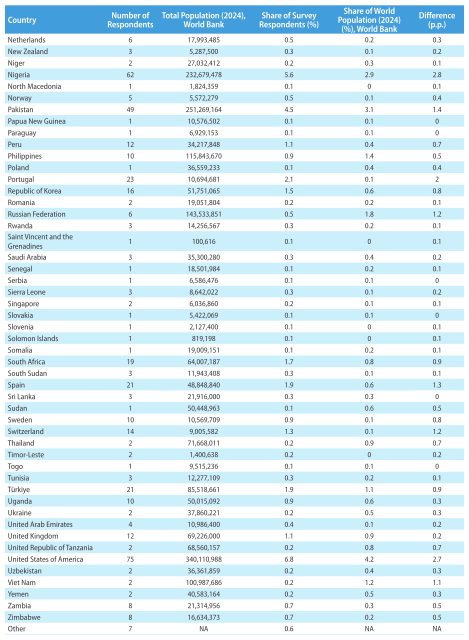
The SDSN also surveyed the broader ecosystem of actors involved in implementing sustainable development at the country level. Compared with the SDSN Expert Survey, the “2026 Survey on SDG Challenges and Means for Implementation” targeted more broadly SDSN’s member institutions and public and private organizations involved in SDG interventions at the national and local levels – beyond SDSN host institutions. In total, 1,098 respondents from 127 countries completed the survey. Results were anonymized before analysis. They should be interpreted with caution, as the sample is not representative of the share of population in each country. For example, China and India are underrepresented relative to their shares of the global population, whereas Australia, Canada, Greece, Italy, Mexico and Malaysia are overrepresented.
Data was collected from November 2025 to February 2026, using Google Forms and Microsoft Forms. The survey builds on a similar survey conducted for the 2020 Sustainable Development Report in the context of the COVID-19 pandemic (Sachs et al. 2020).
The global survey results yield three principal findings:
- Firstly, an overwhelming majority of respondents (78 percent) believe that SDG outcomes in their country improved or stagnated over the period 2015–2025, while a minority (22 percent) believe that the situation worsened. Respondents in East Asia and the Pacific and in South Asia tend tobe more positive about SDG progress, whereas respondents in Latin America and the Caribbean and in North America (driven primarily by respondents in the United States) tend to report more negative trends.
- Secondly, across the six SDG transformations, respondents tend to perceive that more ambitious government efforts have been made to implement the transformations related to education (T1) and digital technologies (T6), with less ambitious efforts made to implement the transformation of agri-food systems (T4) and sustainable cities and communities (T5). However, there are significant variations across regions.
- Thirdly, the failure to implement approved strategies (89 percent agreeing) and the shifting geopolitical landscape (87 percent agreeing)are perceived as the most important barriers to implementing the SDGs. By contrast, comparatively fewer respondents identify lack of access to technologies as the main barrier for SDG implementation (65 percent agreeing). Again, there are significant variations across regions.
Figure 4.9 | 2026 Survey on SDG Challenges and Means for Implementation, responses to Question 1
Note: N = 1,091 (7 “other” countries were excluded). Major progress = +2, moderate progress = +1, stagnation = 0, moderate decline = –1, major decline = –2. Overall progress/decline: green = top values, red = bottom values. Average score: greater than 0.5 (green); 0 to 0.5 (grey); less than 0 (red). *Afghanistan and Pakistan are included in MENA in line with the 2026 World Bank Atlas country groupings.
Source: 2026 SDSN Survey on SDG Challenges and Means for Implementation.
Figure 4.10 | 2026 Survey on SDG Challenges and Means for Implementation, responses to Question 2
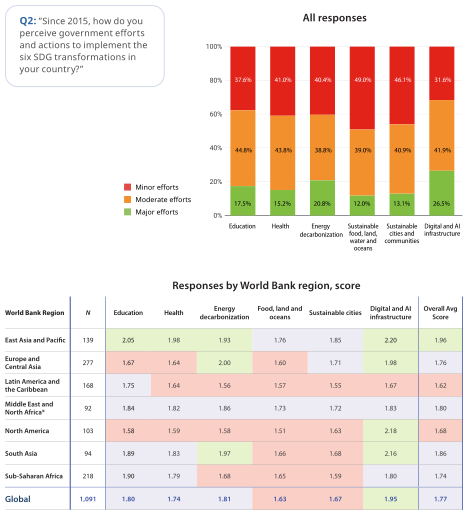
Note: N = 1,091 (7 “other” countries were excluded). Average score per transformation (Major Efforts=3, Moderate Efforts=2, Minor Efforts=1). “No Opinion” excluded from base. N=1,091. Green >1.9; Grey >1.7; Red <1.7. Afghanistan and Pakistan are included in MENA in line with the 2026 World Bank Atlas country groupings.
Source: 2026 SDSN Survey on SDG Challenges and Means for Implementation
Figure 4.11 | 2026 Survey on SDG Challenges and Means for Implementation, responses to Question 3
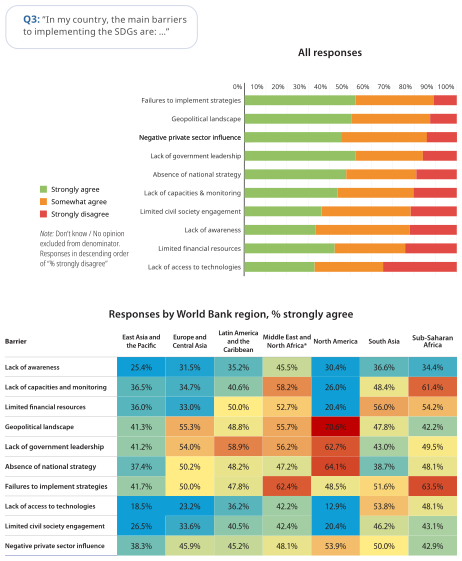
Note: N = 1,091 (7 “other” countries were excluded). Afghanistan and Pakistan are included in MENA in line with the 2026 World Bank Atlas country groupings.
Source: 2026 SDSN Survey on SDG Challenges and Means for Implementation
The open feedback provided by respondents focuses primarily on governance failures. The most central themes discussed relate to political will, governance and corruption, and implementation gaps (or closely related themes). Issues around data and monitoring, financing sustainable development, and climate action are also recurring themes – as well as education, local engagement, and the need to harness digital technologies. Understanding regional patterns in SDG implementation gaps and opportunities, particularly through a more detailed analysis of qualitative survey responses by regions, is an important research and practical priority for the SDSN in the near future.
4.4. Outlook
This chapter provides important insights for accelerating SDG progress and informing governance priorities for the post-2030 Agenda. First, participation in the formal Voluntary National Review (VNR) process is widespread and the preparation of Voluntary Local Reviews (VLRs) is increasing, both signaling strong global momentum for sustainable development. Notably, among G20 countries, the United States remains the only country that has never participated in the VNR process. Second, SDSN’s Expert Survey and largescale survey point to persistent governance challenges and implementation gaps. These include failures to coordinate across government agencies and levels of government, as well as difficulties in implementing adopted strategies and plans due to financing constraints, shifting political priorities, and inadequate engagement with local communities. Such barriers continue to hinder SDG progress. Third, there is broad support among experts for maintaining continuity in the framework beyond 2030, with particular emphasis on strengthening implementation mechanisms in the lead-up to and beyond 2030.
Figure 4.12 | Most-cited terms in open feedback to the SDSN large-scale survey
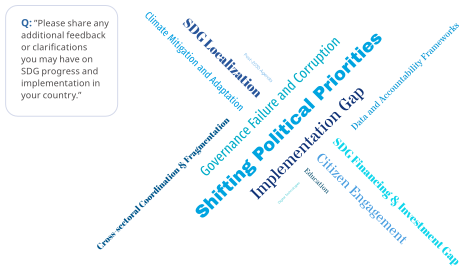
Note: Word size reflects frequency of mention with most-cited terms at centre. The analysis was performed using ClaudeAI (Anthropic).
Source: Authors, using ClaudeAI (Anthropic)
4.5. Annexes
4.5.1. SDSN Expert Survey on Government Efforts – List of experts consulted
Lead coordinator: Dr. Guillaume Lafortune
SDSN Secretariat: core harmonization team (5): María Cortés Puch, Andrija Erac, Grayson Fuller, Guilherme Iablonovski, Samory Touré
SDSN Secretariat: data reviewers (9): Kannan Reghunathan Nair, Gautham Varada Narayan, Amirah Majid, Giovanni Bruna, Marta García-Haro, Isabella Massa, Luka Mach, Raquel Armendariz Sucunza, Zofia Kunysz
Experts and Contributors: (including local SDSN Network Chairs and Managers) (30):Network Chairs and Managers) (30) Pilot countries and respondents : Martin Eriksson (Northern Europe), Jorge Gómez-Paredes (Andes Region), Tahl Kestin (Australia).
Respondents : Lykke Andersen (Bolivia), Norah Asongu (Cameroon), John Barimo (Ireland), Axel Berger (Germany), Chol Bunnag (Thailand), Francine Pace Caruana (Malta), Lamija Ćeremida (Western Balkans), Karen Chand (Malaysia), Christine Daly (Canada), Dimitar Dimitrov (Bulgaria), Maria João Filgueiras Rauch (Portugal), Samuel Hayford (Ghana), Israruddin Israruddin (Indonesia), Dongreal Kang (Republic of Korea), Norichika Kanie (Japan), Phui Yi Kong (Malaysia), Aida Kumarbayeva (Kazakhstan), Francisco Magno (Philippines), Sarah Mendelson (United States), Ngozi Odiaka (Nigeria), Philipp Pattberg (the Netherlands), Elena Preda (Romania), Dimitrios Raptis (Greece), Kamagono Sethono (South Africa), Zuzana Trunečková (Czechia), Maged Zagow (Egypt) and Inge Willems (Belgium).
Some of the experts consulted requested to remain anonymous
4.5.2. SDSN Survey on SDG Challenges and Means for Implementation: share of respondents by country
Table 4.1.a | Survey
Source: Authors’ elaboration based on survey data and population data from World Bank (2026). https://data.worldbank.org/indicator/SP.POP.TOTL.
Table 4.1.b | Survey (continued)
Source: Authors’ elaboration based on survey data and population data from World Bank (2026). https://data.worldbank.org/indicator/SP.POP.TOTL.
Table 4.1.c | Survey (continued)
Source: Authors’ elaboration based on survey data and population data from World Bank (2026). https://data.worldbank.org/indicator/SP.POP.TOTL.
4.5.3. Word clouds: analyses
Claude AI (Anthropic) was used to analyze the qualitative responses received in both surveys. The analysis was conducted on 29 May 2026. The prompt used in both cases was identical: “I have attached an Excel file containing open-ended qualitative survey responses in column A. Please do the following:
Frequency table (Excel output)
- Read all responses and identify the main recurring themes through thematic analysis – not keyword counting, but genuine grouping of related ideas and concepts
- Produce an Excel table with four columns: Rank | Theme (full name, no abbreviations) | Number of responses mentioning this theme | Three or at least two short verbatim example quotes from the data, separated by a pipe character | Please make sure categories are very distinct
- Sort by frequency descending
Generate a topic cloud (most suitable format: Word, Excel or PowerPoint). Display the themes as a topic cloud where font size is PowerPoint). Display the themes as a topic cloud where font size is strictly proportional to frequency. The most frequent themes must appear largest and closest to the center of the slide; least frequent themes must appear smallest at the margins – this is the core requirement. All text in black, white background No overlapping text, no clipped text
The results were compared against those generated using other prompts to assess their sensitivity to prompt wording. This analysis allowed us to confirm that there were marginal differences in results when using slightly different verbatims. We also verified the results via verbatim examples provided for each theme. Figures 4.8 and 4.12 were adjusted and generated by the designer (Pica Publishing). The frequency table is included below. A more detailed academic paper incorporating further regional analysis is in preparation.
Table 4.2 | SDSN Expert Survey: Q.10. ”Please provide any additional information regarding national coordination and implementation initiatives conducted in your country and/or other feedback on the survey.” (Detailed results for word cloud)

Source: Authors, using Claude AI (Anthropic)
Table 4.3 | SDSN Large Scale-Survey: “Please share any additional feedback or clarifications you may have on SDG progress and implementation in your country.” (Detailed results for word cloud)

Source: Authors, using Claude AI (Anthropic)
4.6. References
Impact Iran. 2017. HighLevel Political Forum on Sustainable Development Goals: Civil Society Organization Assessment, Islamic Republic of Iran. July 2017. https://impactiran.org/wp-content/uploads/2018/01/SDG-2017.pdf
Sachs, J. D., G. SchmidtTraub, C. Kroll, G. Lafortune, and G Fuller. 2018. SDG Index and Dashboards Report 2018. Global Responsibilities. Implementing the Goals. Bertelsmann Stiftung and Sustainable Development Solutions Network. http://sdgindex.org/.
Sachs, J. D., G. SchmidtTraub, C. Kroll, G. Lafortune, G. Fuller, and F. Woelm. 2020. Sustainable Development Report 2020. The Sustainable Development Goals and Covid-19. Cambridge University Press. http://sdgindex.org/.
Sachs, J. D., G. SchmidtTraub, M. Mazzucato, D. Messner, N. Nakicenovic, and J. Rockström. 2019. Six transformations to achieve the Sustainable Development Goals. Nature Sustainability 2 (9): 9. https://doi.org/10.1038/s41893-019-0352-9 .
SDSN and OECD. 2019. Long-Term Pathways for the Implementation of the SDGs: the Governance Implications. Reflection Paper. https://irp-cdn.multiscreensite.com/be6d1d56/files/uploaded/OECD_SDSN-Working-Paper_2019_Final.pdf .
UNDESA. 2025. The Important Contribution of Supreme Audit Institutions to SDG Implementation: Follow Up and Review. United Nations Department of Economic and Social Affairs (DESA). Policy Brief n°175.
United Nations. 2015. Transforming Our World: The 2030 Agenda for Sustainable Development. A/RES/70/1. United Nations. https://sustainabledevelopment.un.org/post2015/transformingourworld
UZ Daily. 2025. Uzbekistan’s positions in international rankings discussed in senate. https://www.uzdaily.uz/en/uzbekistans-positions-in-international-rankings-discussed-in-senate/
Van Nguyen. 2026. Vietnam to be among top 50 countries in UN Sustainable Development Goals (SDGs) index in 2026. VnEconomy, January 18. https://en.vneconomy.vn/vietnam-to-be-among-top-50-countries-in-un-sustainable-development-goals-sdgs-index-in-2026.htm
The Sustainable Development Report (formerly the SDG Index & Dashboards) is a global assessment of countries' progress towards achieving the Sustainable Development Goals. It is a complement to the official SDG indicators and the voluntary national reviews.
All data presented on this website are based on the publication Sachs, J.D., Lafortune, G., Fuller, G., Iablonovski, G. (2026). Implementing Sustainable Development: 2030 and Beyond. Sustainable Development Report 2026. Paris: SDSN, Dublin: Dublin University Press. DOI: 10.82163/225
Feedback? Questions? Contact us at info@sdgindex.org