
A.1. Presentation of the SDG Index and Dashboards
The Sustainable Development Report 2026 (SDR26) provides an assessment of progress towards the SDGs for all UN member states. The SDG Index score is presented on a scale of 0 to 100 and can be interpreted as a percentage towards optimal performance on the SDGs. Therefore, the difference between 100 and a country’s SDG Index score is the distance, in percentage points, that must be overcome to reach optimum SDG performance. The same basket of indicators and similar performance thresholds are used for all countries to generate comparable scores and rankings.
Substantial differences in rankings may be due to small differences in aggregate SDG Index scores. This calls for caution when interpreting differences in rankings between countries. Differences of two or three positions between countries should not be interpreted as significant, whereas differences of 10 places may be ascribed to meaningful differences in performance. For further details, see the statistical audit by Papadimitriou et al. (2019) conducted on behalf of the EU Joint Research Centre ( JRC).
The SDG Dashboards provide a visual representation of countries’ performance on the 17 SDGs. The traffic light color scheme (green, yellow, orange and red) illustrates how far a country is from achieving a particular goal. The SDG Dashboards are presented for all UN member states, including countries not included in the SDG Index. As in previous years, the SDG Dashboards and country profiles for OECD countries include additional metrics that are not available for non-OECD member states.
The SDG Trend Dashboards indicate whether a country is on track to achieve each individual goal by 2030, based on past performance. It builds on annual growth rates since 2015, extrapolated to 2030. Indicator trends are aggregated at the goal level to give an indication of how the country is progressing towards that SDG.
The SDR also presents an evaluation of how much each country has progressed on the SDGs since their adoption in 2015. To measure progress, we created a simplified version of the SDG Index (SDGhi) using a headline set of indicators to reduce missing data bias in the timeseries data. The SDGhi was then used to calculate the change in overall score, in percentage points, for all countries with sufficient data.
As last year, we also present an overview of where the world stands on SDG progress, calculated using a population-weigthed average for all UN member states. Unless specified otherwise, all regional average results presented in the report are weighted by population.
This section provides a brief summary of the methods used to compute the SDG Index and Dashboards. A detailed methodology paper is accessible online (Lafortune et al., 2018). The European Commission Joint Research Centre (JRC) conducted an independent statistical audit of the report’s methodology and results in 2019, reviewing the conceptual and statistical coherence of the index structure. The detailed statistical audit report and additional data tables are available on our website: www.sdgtransformationcenter.org . Due to time lags in international statistics, this year’s edition may not fully capture the severe consequences on the SDGs of ongoing wars and other recent geopolitical and security crises.
A.1.1. Changes to the 2026 edition
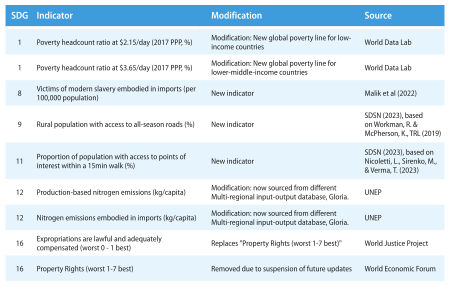
Changes to the indicator set are minimal. This year, we added a new indicator, “Progress towards productive and sustainable agriculture”, produced by the FAO, which measures SDG target 2.4. An additional global indicator on online services and egovernment, sourced from UNDESA, has also been added to SDG 9 (Industry, Innovation and Infrastructure). Table A.1 summarizes these additions and identifies indicators that have been replaced or modified due to changes in the methodology or estimates produced by data providers.
Table A.1 | New indicators and modifications
Source: Authors
A.1.2. SDG Progress
The “headline” SDG Index (SDGhi) measures overall country progress using 17 key indicators, one per SDG. This limited number of indicators aims to minimize statistical biases related to missing timeseries data across countries. The selection of the 17 indicators was based on three criteria: (1) relevance, with most being official SDG indicators or close proxies produced by UN custodian agencies; (2) statistical considerations,namely the ability of the individual SDGhi indicators and the headline total aggregate to closely replicate the goal and SDG Index results through correlation analysis; and (3) data coverage across countries and over time. The 17 headline SDG indicators are listed in Table A.1. For SDG 17, we used a reduced version of the Index of countries’ support for UN-based multilateralism, comprising four indicators with timeseries data:
(1) UNGA votes with the international majority; (2) Participation in conflicts and militarization; (3) Use of unilateral coercive measures and (4) Contributions to the UN budget and International solidarity. Countries missing data for more than two SDGhi indicators were excluded for comparability purposes.
A.1.3. Limitations
Due to changes in the indicators and refinements to the methodology, SDG Index rankings and scores from one edition cannot be compared with the results from previous editions. This year, however, Part 2 provides, for the first time, an overview of changes in rankings over time for the largest countries, using the same indicator set to ensure comparability. As in previous years, we have also calculated time series for the full SDG Index retroactively, using this year’s indicators and methods to provide results that are comparable across time. These series are available for download online and on our interactive data visualization at sdgtransformationcenter.org.
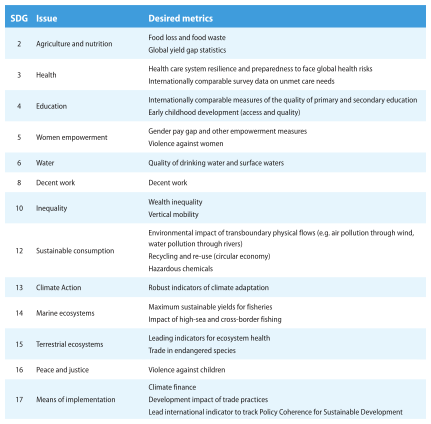
Despite our best efforts to identify data for the SDGs, several indicator and data gaps persist at the international level. These include issues such as food loss and waste (SDG 2), preparedness against global health risks (SDG 3), violence against women (SDG 5), climate adaptation (SDG 13), and a global indicator on policy coherence for sustainable development (SDG 17). The United Nations has further documented persisting data gaps in tracking SDG progress (Goessmann et al. 2023).
To ensure the results are comparable across countries, we do not incorporate estimates received directly from national statistical offices. Rather, we rely on processes in place in international organizations to ensure comparability. As a result, some data points presented in this report may differ from data available from national sources. Moreover, the length of the validation processes by international organizations can lead to significant delays in publishing some data. National statistical offices may therefore have more recent data for some indicators than those presented in this report.
The increased frequency of various forms of conflicts poses a challenge for computing timely and accurate estimates of SDG performance and progress. Due to time lags in international statistics, major breaks in data series may not be reflected in the SDG Index. Such time lags might be exacerbated by the greater difficulties faced by National Statistical Offices (NSOs) in compiling, collecting and publishing statistics during conflict. Figure A1 compares SDG Index scores with the intensity of conflicts in each country, using data from ACLED (Armed Conflict Location and Event Dataset) on conflict-related fatalities as a proxy, and calls for prudence in interpreting the results for countries shown within the grey area of the chart.
Figure A.1 | Uncertainty in SDG Index Score Accuracy: 2026 SDG Index Score vs Intensity of Conflicts
Note: The zone in purple depicts countries where confidence is lower due to exposure to large-scale recent conflict.
Source: Authors.
A.2. Methodology
The SDG Index provides a comprehensive assessment of distance to targets, based on the most up-to-date data available for all 193 UN member states. This year’s report includes 101 global indicators, as well as a further 22 indicators specifically for OECD country dashboards, reflecting better data coverage for these countries.
The following sections provide an overview of the methodology used for indicator selection, normalization and aggregation, and for generating indications on trends over time. Additional information including raw data, additional data tables and sensitivity tests, is available online.
Where possible, we use official SDG indicators endorsed by the UN Statistical Commission. Where there are data gaps or insufficient data available for an official indicator, we include other metrics from official and unofficial providers. We used five criteria in selecting indicators suitable for inclusion in the report:
- Their global relevance and applicability to a broad range of country settings.
- Statistical adequacy: the indicators represent valid and reliable measures.
- Timeliness: the indicators are current and published on a timely schedule.
- Coverage: data is available for at least 80 percent of UN member states with a population greater than 1 million.
- Possibility of measuring distance to target (optimal performance can be defined).
A.2.1. Data sources
The data come from a mix of official and non-official data sources. Most of the data (around two thirds) come from international organizations that have extensive and rigorous data validation processes (including World Bank, OECD, WHO, FAO, ILO and UNICEF).
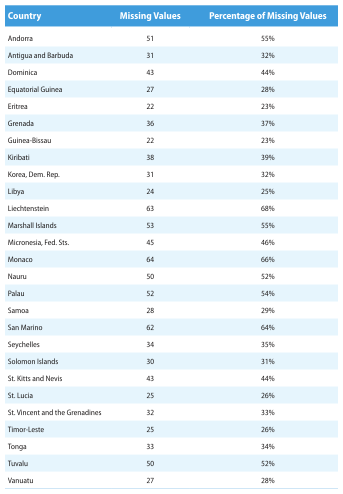
Table A.2 | Countries excluded from the 2026 SDG Index due to insufficient data
Source: Authors
Around one-third of the data come from less traditional sources, including household surveys, such as the Gallup World Poll, and datasets produced by civil society organizations and networks (Oxfam, the Tax Justice Network, the World Justice Project, Reporters Without Borders), peer-reviewed journals (for example, data to track international spillovers), and geographic information systems (GIS). These non-official sources complement official data and help improve the data availability and timeliness for key SDG indicators and targets. The full list of indicators and data sources is provided in Table A.4 and online. The data for this year’s edition were extracted between March and April 2026.
A.2.2. Missing data and imputations
To minimize biases from missing data, the SDG Index in general only includes countries that have data for at least 80 percent of the indicators. We make an exception, however, for countries that have been included in previous editions of the SDG Index, as long as they are not missing more than 25 percent of the data. The list of countries excluded from the SDG Index due to missing data is presented in Table A.2. We include all UN member countries in the SDG Dashboards and country profiles, which also indicate any gaps in available SDG data for each country. We generally do not impute or model missing data, apart from a few exceptional circumstances. The list of indicators that include imputed data is available online in the Codebook.
A.3. Method for constructing the SDG Index and Dashboards
The procedure used to calculate the SDG Index comprises three steps: (i) establish performance thresholds and censor extreme values from the distribution of each indicator; (ii) rescale the data to ensure comparability across indicators (normalization); and (iii) aggregate the indicators within and across SDGs.
A.3.1. Establishing performance thresholds
To make the data comparable across indicators, each variable was rescaled from 0 to 100, with 0 denoting worst performance and 100 describing the optimum. Rescaling is sensitive to the choice of limits and to extreme values (outliers) – which could become unintended thresholds and introduce spurious variability in the data. Consequently, the choice of upper and lower bounds can affect the relative ranking of countries in the index.
The upper bound for each indicator was determined using the following decision tree:
- Use absolute quantitative thresholds in SDGs and targets: zero poverty, universal school completion, universal access to water and sanitation, full gender equality.
- Where no explicit SDG target is available, apply the principle of “leave no one behind” to set the upper bound at universal access or zero deprivation.
- Where science-based targets exist that must be achieved by 2030 or later, use these to set the 100 percent upper bound (such as zero greenhouse gas emissions from CO2 as required by 2050 to stay within 1.5°C, or 100-percent sustainable management of fisheries).
- For all other indicators, use the average of the top five performers.
These principles interpret the SDGs as “stretch targets” and focus attention on those indicators on which a country is lagging. The lower bound is defined at the2.5th percentile of the distribution. Each indicator distribution is censored, so that all values exceeding the upper bound score 100, and values below the lower bound score 0.
A.3.2. Normalization
After establishing the upper and lower bounds, variables were transformed linearly to a scale between 0 and 100 using the following rescaling formula for the range [0; 100]:
Image A.1 | Formula
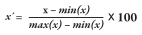
where x is the raw data value; max/min denote the upper and lower bounds, respectively; and x’ is the normalized value after rescaling.
The rescaling equation ensured that all rescaled variables were expressed as ascending variables (i.e., higher values denoted better performance). In this way, the rescaled data became easy to interpret and compare across all indicators: a country that scores 50on a variable is halfway towards achieving the optimum value; a country with a score of 75 has covered three quarters of the distance from worst to best.
A.3.3. Weighting and aggregation
Several rounds of expert consultations on earlier drafts of the SDG Index made it clear that there was no consensus across different epistemic communities on assigning higher weights to some SDGs over others. As a normative assumption, we therefore opted to give fixed, equal weight to every SDG – reflecting policymakers’ commitment to treating all SDGs equally and as part of an integrated and indivisible set. This implies that, to improve their SDG Index score, countries need to address all goals, giving particular attention to those they are furthest from achieving and where incremental progress might therefore be expected to be fastest.
To compute the SDG Index, we first estimate a country’s scores on each goal using the arithmetic mean of its scores on the goal’s indicators. The resultant scores are then averaged across all 17 SDGs to obtain the country’s SDG Index score.
The results of various sensitivity tests are available online, including comparisons of arithmetic mean versus geometric mean and Monte-Carlo simulations at the Index and Goal level. Monte-Carlo simulations call for prudence in interpreting small differences in Index scores and rankings across countries, as they may be sensitive to the weighting scheme.
A.3.4. Dashboards
We introduce additional quantitative thresholds for each indicator to group countries in a “traffic light” table. Thresholds have been established based on statistical techniques and through various rounds of consultations with experts conducted since 2016.
Averaging across all indicators for an SDG might hide areas of policy concern if a country performs well on most indicators but faces serious shortfalls on one or two metrics within the same SDG (often referred to as the issue “substitutability” or “compensation”). This applies particularly to high-income and upper-middle-income countries that have made significant progress on many SDG dimensions but may face serious shortfalls on individual variables, for example on the sustainability of diets and agriculture within SDG 2. As a result, the SDG Dashboards focus exclusively on the two variables on which a country performs worst. We also apply an additional rule, by which a red rating is assigned only if a country scores red on both of its worst-performing indicators. Similarly, to score green, its scores on both of these indicators must be green. The quantitative thresholds used for generating the dashboards are available in Table A.4.
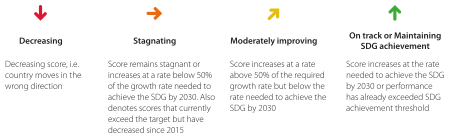
Figure A.2 | The Four-arrow system for denoting SDG trends
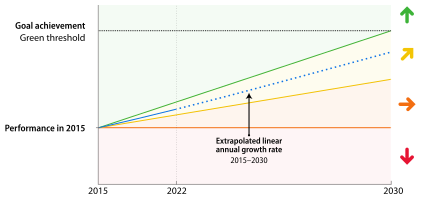
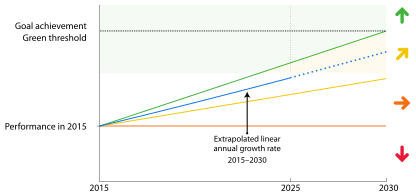
Figure A.3 | Graphic representation of the methodology for SDG trends
Source: Authors
A.3.5. SDG trends
Using historic data, we estimate how fast a country has been progressing towards achieving each SDG and whether – if extrapolated into the future – this pace will be sufficient to achieve the goal by 2030. For each indicator, achievement is defined by the green threshold established for the SDG Dashboards. The difference in percentage points between the green threshold and the country’s normalized score denotes the gap that must be closed to meet that goal. To estimate trends at the indicator level, we calculate the linear annual growth rates (annual percentage improvements) needed to achieve the target by 2030 (rates across 2015–2030), which we compare to the average annual growth rate since the adoption of the SDGs in 2015 (for this edition, 2015–2025). Progress towards achievement on a particular indicator is described using a 4-arrow system (Figure A.1). Figure A.2.2 illustrates the methodology graphically. Because time series data is required for these calculations, indicators with only one or very few data points across time could not be used for these analyses. The set of indicators used to generate the trend indications is available in Table A.4.
Because projections are based on the long-term growth rate since 2015, a country may have experienced a decline in performance in the past year but still be considered on track. This methodology emphasizes long-term structural changes since the adoption of the SDGs in 2015, rather than annual changes that may be cyclical or temporary. Countries that currently meet or surpass an indicator target but have recorded a decline on that indicator since 2015 are assigned an orange arrow for that indicator. This is because the country may no longer meet the SDG target in the future if the decreasing trend continues.
A.3.6. Status of SDG targets
In addition to the SDG Index, dashboards and trends, we also present an assessment of the status of SDG targets for the world. This assessment uses only trend indicators (Table A.4), as timeseries data is needed to calculate rates of progress. Where the past rate of progress would be sufficient to meet the target by 2030 – corresponding to the green arrow, “On track or maintaining SDG achievement” – the indicator is counted as on track. Indicators for which past rates of progress are insufficient to meet the SDG target – corresponding to the orange “stagnating”or yellow “moderately improving” arrows – are counted as showing limited progress. Finally, indicators moving in the wrong direction – corresponding to the red “decreasing” arrow – are counted as worsening. To assess the status of SDG targets for the world (population-weighted average), we only consider as on track those indicators that show consistent progress both over the long term (since 2015) and in the short term (the most recent year of reference for the indicator).
Table A.3 | Spillover indicators and categories
Note: *Denotes OECD only indicator
Source: Authors
A.3.7. International Spillover Index
The 2026 International Spillover Index tracks the impacts of a given country’s actions on others. The Sustainable Development Report 2026 presents 14 spillover indicators (Table A.3), including one – the Financial Secrecy Score – that appears only in the dashboards for OECD countries. The remaining 13 indicators are used to calculate each country’s International Spillover Index score.
These indicators can be organized into three categories of international spillovers: 1) environmental and social impacts embodied in trade; 2) impacts related to economy and finance, and 3) impacts related to UN-based multilateralism, peace and security. The International Spillover Index score is calculated as the arithmetic average of a country’s scores across all spillovers indicators, weighted equally. The score ranges from 0 to 100, where a lower score denotes more negative spillover impacts and a higher score denotes fewer negative spillover impacts.
Table A.4.a | Indicators included in the Sustainable Development Report 2026
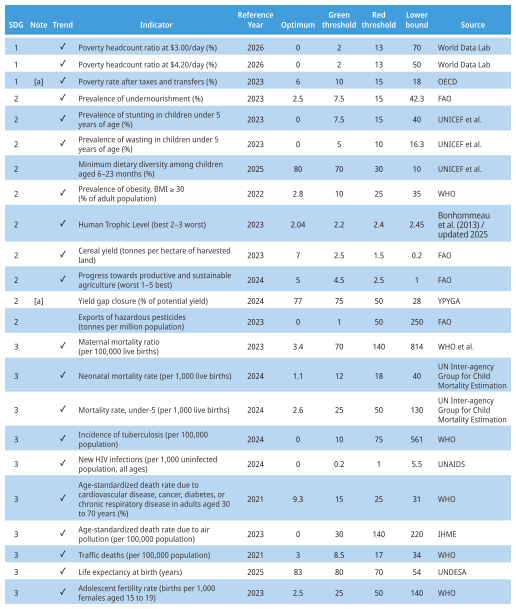
Note: [a] denotes OECD-only indicators [b] denotes indicators not used in OECD dashboard but that are used in the calculation of OECD countries’ index scores. The inclusion of an indicator on the export of major conventional weapons should not be interpreted as a value judgment by the authors on the policies implemented in the context of the war in Ukraine, but rather as an effort to evaluate more generally trends towards disarmament recognized by the UN and civil society organizations as an important priority for peace, socio-economic stability and sustainable development (UN Office for Disarmament Affairs, 2018; Amnesty International, 2008).
Source: Authors
Table A.4.b | Indicators included in the Sustainable Development Report 2026 (continued)
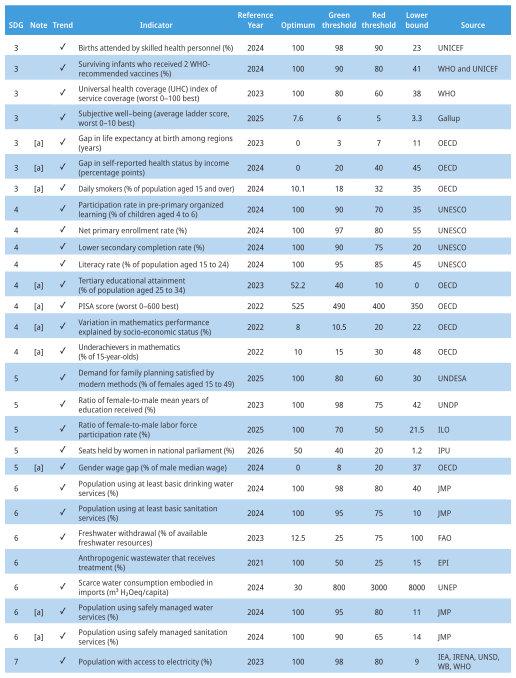
Note: [a] denotes OECD-only indicators [b] denotes indicators not used in OECD dashboard but that are used in the calculation of OECD countries’ index scores. The inclusion of an indicator on the export of major conventional weapons should not be interpreted as a value judgment by the authors on the policies implemented in the context of the war in Ukraine, but rather as an effort to evaluate more generally trends towards disarmament recognized by the UN and civil society organizations as an important priority for peace, socio-economic stability and sustainable development (UN Office for Disarmament Affairs, 2018; Amnesty International, 2008).
Source: Authors
Table A.4.c | Indicators included in the Sustainable Development Report 2026 (continued)
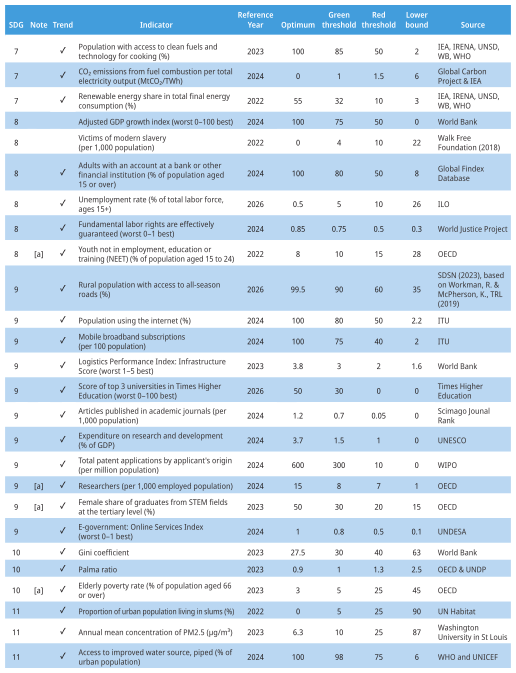
Note: [a] denotes OECD-only indicators [b] denotes indicators not used in OECD dashboard but that are used in the calculation of OECD countries’ index scores. The inclusion of an indicator on the export of major conventional weapons should not be interpreted as a value judgment by the authors on the policies implemented in the context of the war in Ukraine, but rather as an effort to evaluate more generally trends towards disarmament recognized by the UN and civil society organizations as an important priority for peace, socio-economic stability and sustainable development (UN Office for Disarmament Affairs, 2018; Amnesty International, 2008).
Source: Authors
Table A.4.d | Indicators included in the Sustainable Development Report 2026 (continued)
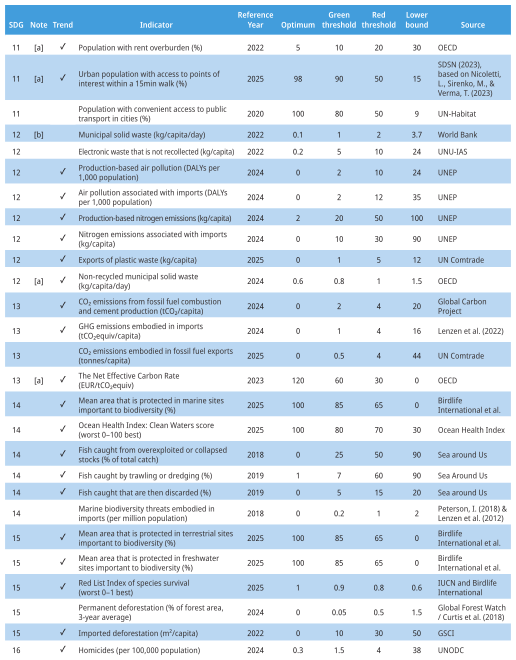
Note: [a] denotes OECD-only indicators [b] denotes indicators not used in OECD dashboard but that are used in the calculation of OECD countries’ index scores. The inclusion of an indicator on the export of major conventional weapons should not be interpreted as a value judgment by the authors on the policies implemented in the context of the war in Ukraine, but rather as an effort to evaluate more generally trends towards disarmament recognized by the UN and civil society organizations as an important priority for peace, socio-economic stability and sustainable development (UN Office for Disarmament Affairs, 2018; Amnesty International, 2008).
Source: Authors
Table A.4.e | Indicators included in the Sustainable Development Report 2026 (continued)
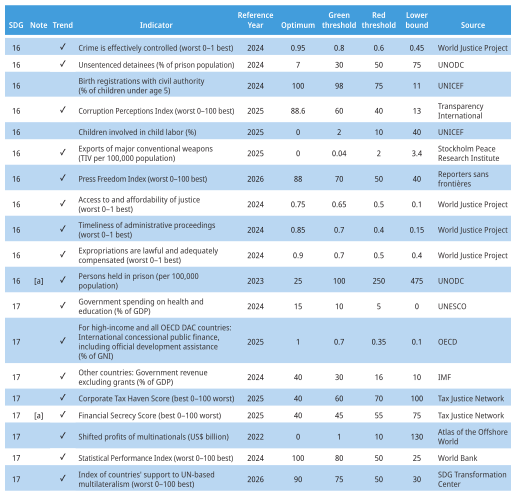
Note: [a] denotes OECD-only indicators [b] denotes indicators not used in OECD dashboard but that are used in the calculation of OECD countries’ index scores. The inclusion of an indicator on the export of major conventional weapons should not be interpreted as a value judgment by the authors on the policies implemented in the context of the war in Ukraine, but rather as an effort to evaluate more generally trends towards disarmament recognized by the UN and civil society organizations as an important priority for peace, socio-economic stability and sustainable development (UN Office for Disarmament Affairs, 2018; Amnesty International, 2008).
Source: Authors
A.4. References
Alsamawi, A., Murray, J., Lenzen, M., and Reyes, R. C. 2017. Trade in occupational safety and health: Tracing the embodied human and economic harm in labour along the global supply chain. Journal of Cleaner Production, 147, 187–96.
Amnesty International. 2008. Blood at the Crossroads: Making the Case for a Global Arms Trade Treaty. London, UK: Amnesty International Publications. https://controlarms.org/wp-content/uploads/2018/03/act300112008en.pdf
Goessmann, C., P. Idele, K. Jauer, M. Loinig, C. Melamed, and T. Zak. 2023. Pulse of Progress: Mapping the State of Global SDG Data in 2023. United Nations
Lafortune, G., G. Fuller, J. Moreno, G. SchmidtTraub, and C. Kroll. 2018. SDG Index and Dashboards: detailed Methodological paper. Bertelsmann Stiftung and Sustainable Development Solutions Network, Paris
Malik, A., Lafortune, G., Mora, C., Carter, S., and Lenzen M. 2022. International spillovers embodied in the EU’s supply chains. GIZ, SDSN, and the University of Sydney. https://irp.cdn-website.com/be6d1d56/files/uploaded/56690-1%20-%20SDSN%20Study%20-%20v3.pdf
Papadimitriou, Eleni, Ana Neves, and William Becker. 2019. JRC Statistical Audit of the Sustainable Development Goals Index and Dashboards. European Commission, Joint Research Centre. doi:10.2760/723763, JRC116857
UNODA. 2018. Securing our Common Future: An Agenda for Disarmament. United Nations Office for Disarmament Affairs. https://front.un-arm.org/wp-content/uploads/2018/06/sg-disarmament-agenda-pubs-page.pdf
The Sustainable Development Report (formerly the SDG Index & Dashboards) is a global assessment of countries' progress towards achieving the Sustainable Development Goals. It is a complement to the official SDG indicators and the voluntary national reviews.
All data presented on this website are based on the publication Sachs, J.D., Lafortune, G., Fuller, G., Iablonovski, G. (2026). Implementing Sustainable Development: 2030 and Beyond. Sustainable Development Report 2026. Paris: SDSN, Dublin: Dublin University Press. DOI: 10.82163/225
Feedback? Questions? Contact us at info@sdgindex.org